AZ almost didn’t answer the call.
It was an ordinary weekday, the kind where you find yourself thinking about dinner, upcoming bills, and looming school deadlines. Her husband, Ralph, had left early and assured her he’d be home before the kids finished their homework.
He took the same route he always did—the familiar corners, the shortcuts he trusted, and that familiar confidence of “I know this road.”
That’s the scary part about road accidents in the Philippines: they can happen at any time. You don’t need to be on a long trip, or in bad weather, or even on a holiday. They can occur in the middle of a typical day, on streets you believe you know well.
When an accident happens, the issue extends beyond just injuries. It creates a ripple effect that shifts the entire household.
This is why road safety is a family matter, not just a traffic concern.
The pattern people miss: ordinary roads, life-changing outcomes
Many people believe that road crashes only happen to “other people,” or they think the risks are limited to highways, late nights, or long drives.
However, data from Metro Manila reveals that this is a persistent issue. According to the MMDA, the region experiences an average of 92,583 road crashes each year, resulting in approximately 410 fatalities annually.
This is not an infrequent occurrence; it’s a regular issue.
The MMDA has also introduced a road safety plan for 2024–2028, aiming to reduce road crash deaths by 35% by 2028.
While having clear targets and plans is important, daily behavior is also crucial, as the next crash could happen at any moment, regardless of long-term strategies.
Who gets hurt the most: the riders, the walkers, the working-age
In many Filipino households, motorcycles serve as essential transport. They are how people get to work, pick up kids, deliver goods, and manage a budget.
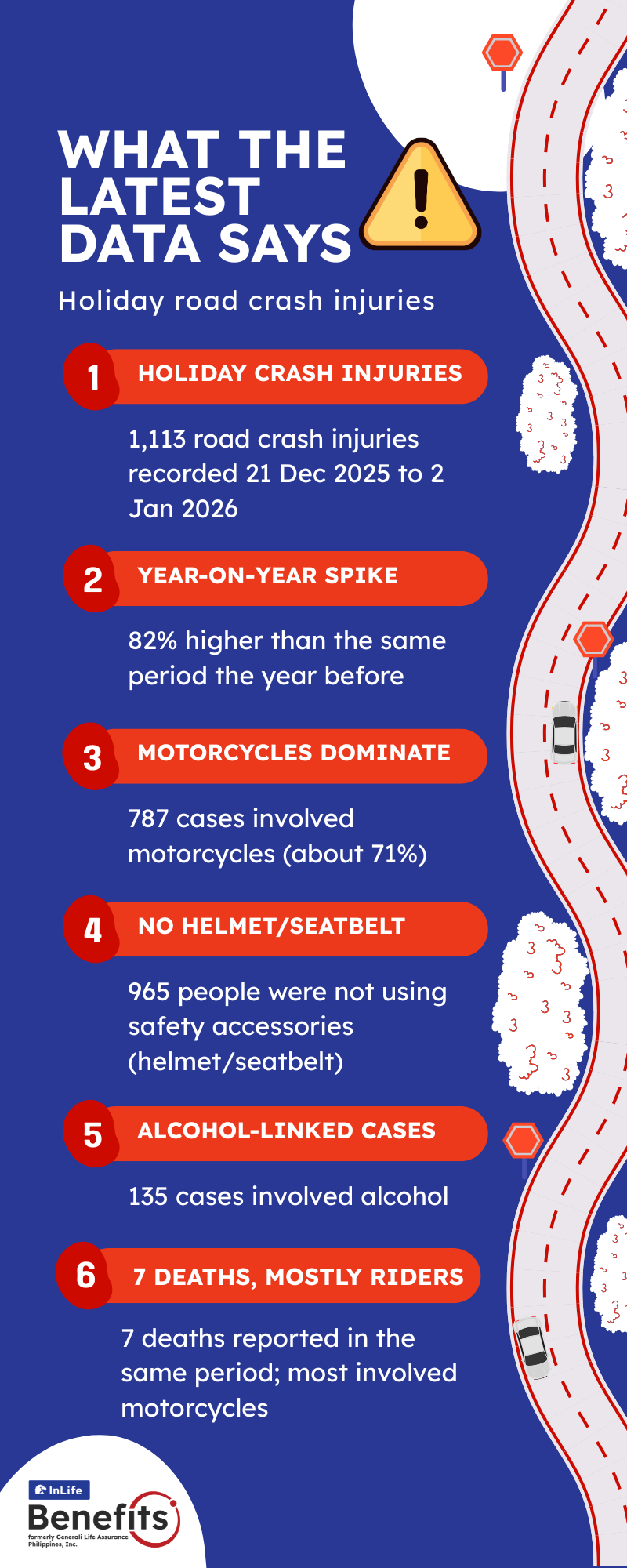
That’s why the DOH holiday statistics are concerning. Most recorded injuries involved motorcycles, and many riders were not wearing helmets or seatbelts.
Crashes have a significant impact on families, as riders and pedestrians generally have less protection during collisions. The body absorbs the full force of the impact.
Age also plays a crucial role in this issue. According to the DOH holiday surveillance data, many reported injuries involved young people aged 15 to 29.
This age group includes many breadwinners, students, and young parents, making it a substantial concern.
When it happens, the worst part comes after the crash
Mika’s first thought was to go to the hospital. Her second thought was, “How much will this cost?”
This is an important aspect that many people overlook.
A road crash can result in several consequences, including:
- Missed work (sometimes for weeks)
- A family member becoming a full-time caregiver
- Medical bills, transportation costs, and follow-up appointments
- Stress that disrupts how a household operates
Even if someone survives, the family still incurs costs in terms of time, money, and emotional strain.
So when we discuss road safety, we are essentially talking about family stability.
Why “I know this road” can be a trap
Familiarity can make people careless.
On your usual route:
- You glance at your phone because you “know the timing”
- You speed up because you “just want to get home”
- You take gaps you wouldn’t take in an unfamiliar place
But the road changes daily:
- A jeepney stops suddenly
- A pedestrian crosses where there’s no lane
- A pothole forces a swerve
- A vehicle cuts in because traffic is tight
Even during Holy Week 2025, the MMDA recorded 23 vehicular crashes in Metro Manila, resulting in 12 injuries.
Routine does not guarantee safety.
Big crashes make headlines, but everyday crashes build the real toll
A major accident can have a profound impact on the country. For instance, the incident on May 1, 2025, in Tarlac, when a bus crashed into several vehicles at a toll booth, resulted in the death of 10 people.
While stories like that spread quickly, smaller accidents occur quietly every day, contributing to a continuous national issue.
A public safety announcement released in 2025 reported that deaths from land transport accidents reached 13,125 in 2023, the highest number in over a decade. Additionally, it highlighted that young adults aged 20 to 24 consistently experience high rates of fatalities in land transport accidents.
This isn’t just “old news”; it remains the ongoing reality we are facing in 2025 and early 2026.
Enforcement matters, but personal choices still decide outcomes
Road safety discussions often focus solely on “stricter enforcement.” While enforcement is important, it’s crucial to examine the findings from the Department of Health (DOH) during the holiday period:
- Most injuries involved motorcycles.
- Many individuals were not wearing helmets or seatbelts.
- Alcohol was a factor in a significant number of cases.
These issues go beyond systemic problems; they also reflect behavioral challenges.
The DOH is advocating for safer policies and habits to reduce fatalities, including support for implementing lower speed limits on city and municipal streets (30 km/h) as outlined in the traffic code.
Although reducing speed may seem trivial at the moment, it plays a vital role in determining survival.
In case of a road accident: who to call and what to do
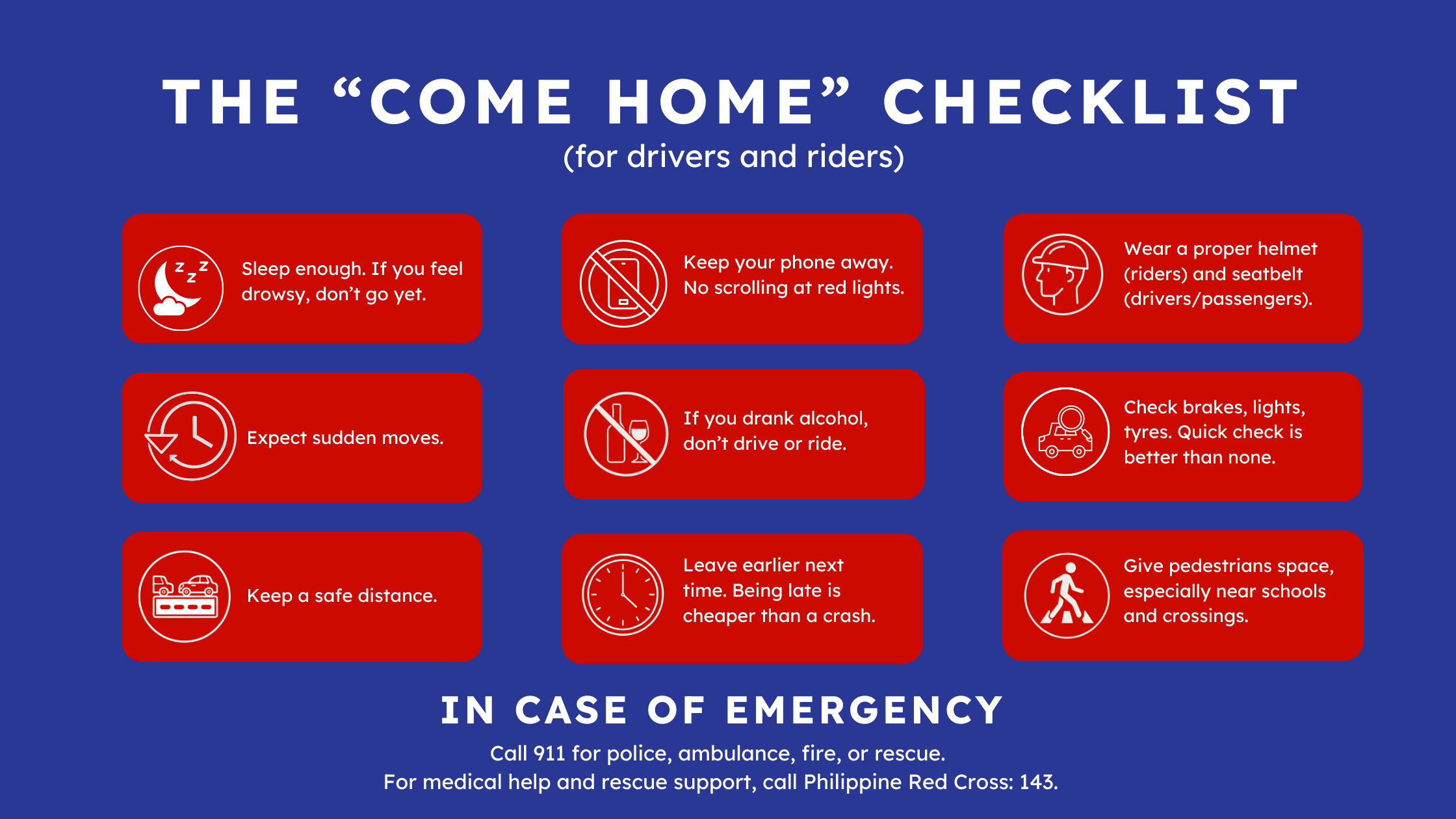
If a crash happens, focus on two things: safety first, then fast help.
- Call 911 for immediate emergency response (anywhere in the Philippines) Dial 911 for police, ambulance/medical help, fire, and rescue. The government rolled out Unified 911 as a single hotline nationwide, free and available 24/7.
- If you need rescue/medical support and can’t reach local help, call Philippine Red Cross 143 Dial 143 to reach the Philippine Red Cross emergency hotline.
- What to do while waiting for help
- Move to a safe spot if you can (away from traffic).
- Do not move an injured person if you suspect a head, neck, or back injury, unless there’s immediate danger (like fire).
- Check breathing and bleeding. If there’s heavy bleeding, apply firm pressure using a clean cloth.
- If it’s safe, switch on hazard lights and place warnings (triangle, cones, or anything visible).
- Take photos of the scene only when it’s safe to do so.
- What to tell the operator (quick script)
Say this in order:- Your exact location (landmark, barangay, road name, nearest intersection)
- What happened (crash, hit-and-run, vehicle vs pedestrian, etc.)
- How many are injured, and if anyone is unconscious or bleeding
- Any hazards (fuel leak, smoke, fire, blocked road)
- Your name and mobile number
- If you can’t get through
- Ask someone nearby to call 911 or 143 using their phone.
- If there’s no signal, go to the nearest barangay hall, police station, fire station, or public hospital/clinic and ask them to contact responders.
A real road safety mindset: “My family deserves my best attention.”
Road safety messages often come across like a lecture, causing people to tune out. Here’s a better way to frame it: attention is a form of care.
When you drive or ride, your attention protects:
- Your passengers
- Pedestrians
- Other families on the road
- Your own household’s future
As a parent, partner, or caregiver, your family doesn’t need you to be perfect; they need you to be present.
What InLife Benefits wants people to take from this
Life can be overwhelming. Commutes are long, roads are crowded, and days are filled with tasks.
That’s why road safety isn’t “extra.” It’s an essential part of taking care of your loved ones.
If you remember only one line, let it be this: Don’t drive like you’re alone; someone is waiting for you.
The safest journey isn’t the fastest; it’s the one that brings you home.
Care extends beyond the road.
If someone in your family commutes every day, make sure you’re prepared for the unexpected. Explore InLife Benefits’ Assist products and choose the coverage that fits your routine:
https://shop.generali.com.ph/
Sources
- “DOH: Road accidents amid holidays reach 1,113” — GMA News Online — 2 January 2026
- “DOH: 7 deaths in 1,113 road crashes” — The Philippine Star — 3 January 2026
- “DOH road crash injuries hit 1,113” — Daily Tribune — 3 January 2026
- “MMDA to host road safety summit, unveil 5-year plan” — Philippine Information Agency — 25 June 2025
- “23 road crashes logged in Metro Manila during Holy Week” — The Philippine Star — 22 April 2025
- “Land transport accidents account 1.9 percent of deaths in the country…” — Philippine Statistics Authority — 7 May 2025
- “DOH pushes for road safety practices, policies” — Philippine News Agency — 2025
- “10 dead, dozens hurt in SCTEX toll plaza multiple-vehicle collision” — GMA News Online — 1 May 2025
- “10 killed in Philippines when passenger bus slams into vehicles at a toll booth” — Associated Press — 1 May 2025